
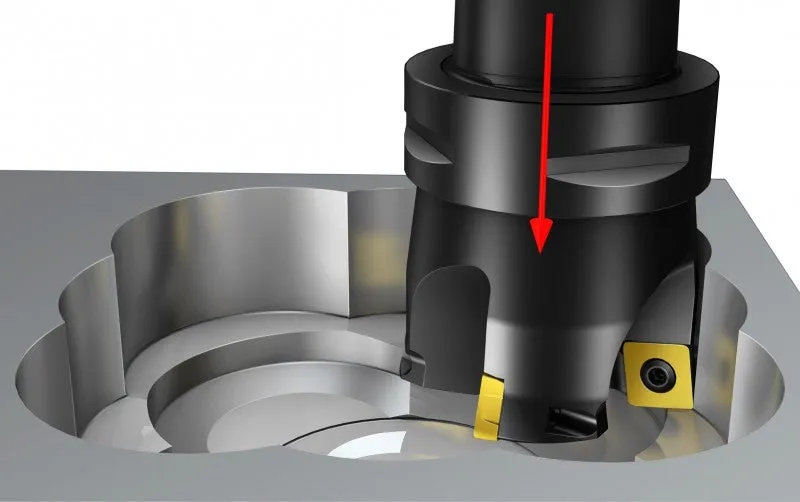
CNC high-accuracy plunge milling has become one of the most reliable machining strategies for manufacturing deep-core rotor hub cavities, especially in aerospace, renewable energy, and high-performance industrial machinery. As rotor hubs grow more complex in geometry and structural requirements, manufacturers face challenges related to tool deflection, chip evacuation, thermal expansion, and the need for consistent dimensional accuracy across deeper cavity zones. Plunge milling addresses these constraints by allowing axial loading of the cutting tool, reducing radial forces, and enabling far more stable engagement when working with long-reach tooling inside confined spaces. In modern shops that prioritize process reliability and part traceability, this method provides a practical balance between cycle-time efficiency and predictable surface integrity. With the continued adoption of advanced 5-axis CNC machines and software-enabled toolpath refinements, plunge milling has evolved into a benchmark strategy for deep cavity production where precision, strength, and repeatability are non-negotiable.
The engineering advantage of plunge milling becomes particularly evident when machining materials commonly used for rotor hubs, such as high-strength steels, titanium alloys, and advanced aluminum compositions. Traditional side milling in deep cavities often introduces vibration, chatter, and tool bending, leading to poor surface quality, inaccurate cavity depths, and costly tool wear. Plunge milling, on the other hand, minimizes the reliance on radial engagement and instead leverages the tool’s axial strength, delivering a more controlled removal rate even at significant depths. This approach allows CNC programmers to apply stable toolpaths with repeatable Z-axis plunges that maintain consistent cutting loads throughout the operation. The resulting geometry tends to be cleaner and more uniform, contributing to better mechanical fit and improved fatigue performance for rotor assemblies exposed to dynamic loads and extreme rotational forces. With the right combination of high-rigidity machine setups, optimized feeds and speeds, and advanced tool coatings, manufacturers can secure superior productivity and quality even when handling challenging aerospace-grade materials.
As rotor hub designs become more intricate, plunge milling plays an essential role in handling multi-level cavity structures, cross-sectional transitions, and internal fillets without compromising accuracy. Deep-core cavities often require precise alignment of multiple internal surfaces, and any deviation from the tolerance envelope can cause assembly misalignment or decreased rotational stability. Plunge milling assists in managing these risks by reducing radial drift and enabling a straight, controlled toolpath that mirrors the cavity’s vertical geometry. CAM software enhancements further improve this process by automating step-down strategies, optimizing entry angles, and simulating tool engagement patterns to prevent sudden load spikes. Many modern toolpath engines also integrate adaptive positioning, allowing the machine to dynamically adjust plunge rates in response to load conditions. These algorithm-based refinements give manufacturers the confidence to push deeper and more aggressively into material without sacrificing part accuracy or risking catastrophic tool failure. For rotor hub designs that incorporate weight-reduction pockets, asymmetric cavity floors, or cooling-channel interfaces, plunge milling proves especially valuable due to its predictable cutting behavior in narrow, difficult-to-access zones.
Another advantage of plunge milling for deep-core rotor hub cavities is the improvement in thermal stability and heat evacuation. Deep cavity machining often deals with increased heat generation due to prolonged tool engagement and limited coolant access, which can compromise microstructure integrity and surface finish. Plunge milling reduces these issues by shortening the engagement interval and dispersing heat over smaller axial sections. This technique also enhances chip breakage and facilitates more efficient chip evacuation compared to side milling, where long chips tend to pack within the cavity and damage the tool edge. With high-pressure coolant systems and through-tool coolant channels, manufacturers can maximize cooling efficiency, ensuring stable thermal conditions throughout the plunge process. The reduced heat buildup also lowers the risk of micro-cracking, burr formation, and dimensional deformations—critical factors for rotor hubs that must maintain long-term structural performance under high rotational loads. Furthermore, enhanced heat control supports extended tool life, reducing downtime and boosting overall manufacturing throughput.
From an operational perspective, plunge milling introduces measurable improvements in cycle-time optimization and workflow stability. When cutting deep rotor hub cavities, traditional milling requires numerous radial passes, tool sharpening, and frequent adjustments to avoid deflection-induced errors. Plunge milling streamlines these routines by defining vertical cutting sequences that maintain consistent material removal without repeated repositioning. This reduction in tool-path complexity minimizes machine idle time and reduces the opportunity for operator-induced errors. Moreover, plunge milling works exceptionally well with modern high-speed spindle technologies and rigid machine frameworks, enabling manufacturers to leverage faster feed rates without sacrificing part integrity. Combined with real-time monitoring tools such as load sensors and spindle vibration analysis, operators can maintain peak machining efficiency with predictive maintenance and immediate corrective adjustments. In high-volume production environments where rotor hub assemblies are produced at scale, these advantages translate into lower per-part costs and improved operational resilience, ensuring the shop remains competitive in demanding aerospace and industrial markets.
Ultimately, CNC high-accuracy plunge milling represents a strategic machining approach that empowers manufacturers to efficiently produce deep-core rotor hub cavities with uncompromising precision. Its ability to stabilize cutting forces, improve cavity uniformity, and enhance thermal management makes it increasingly relevant for industries where reliability and structural integrity are key performance metrics. As CNC technology continues to advance and machine-learning-driven toolpath optimization becomes more widespread, plunge milling will play an even larger role in shaping the future of deep-cavity machining. Manufacturers that embrace this technique are better equipped to overcome the challenges posed by next-generation rotor hub designs, ensuring consistent quality, reduced cycle times, and a more scalable production environment. With its proven capability to handle complex geometries and demanding materials, plunge milling stands as an essential pillar of modern CNC machining strategies, supporting innovation and efficiency across global manufacturing ecosystems.