
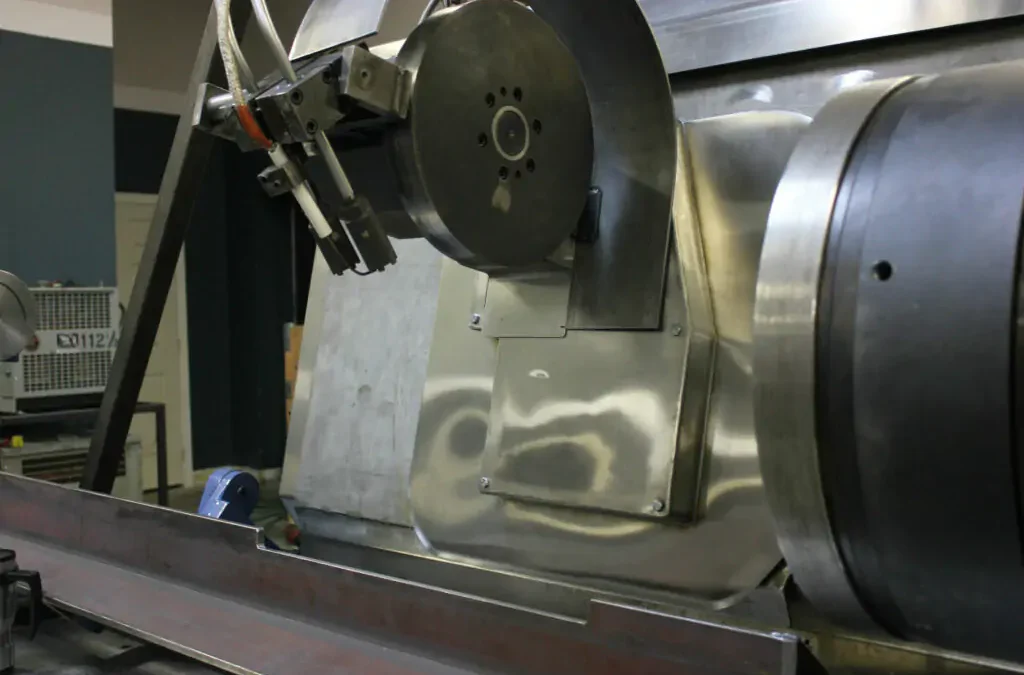
Advanced CNC blend milling has become a foundational machining strategy for manufacturers producing multi-contour exhaust diffuser channels in aerospace, power-generation, and high-performance automotive industries. These components are engineered to regulate high-velocity gas flow, reduce turbulence, and maintain structural stability under extreme thermal and mechanical loads. Because diffuser channels contain complex contours, sweeps, aerodynamic transitions, and interconnected radii, traditional milling approaches often struggle to maintain continuous tool engagement and smooth surface blends. The result is visible step lines, inconsistent curvature transitions, residual stress buildup, and suboptimal aerodynamic performance. CNC blend milling overcomes these limitations by applying multi-axis interpolation, gradual stepovers, and adaptive toolpath behavior to achieve uniform surface flow across compound geometries. With exhaust diffusers becoming more sophisticated in modern turbomachinery—often involving multi-stage curvature zones and variable cross-sectional paths—the need for blend milling strategies that deliver flawless continuity and tolerance stability is more critical than ever. Manufacturers who master this technique gain a significant advantage in producing lightweight, high-precision, and fatigue-resistant diffuser components that meet demanding regulatory and performance benchmarks.
One of the greatest advantages of advanced blend milling is its ability to maintain seamless transitions between different contour zones without introducing sudden changes in chip load or tool pressure. Exhaust diffuser channels typically require smooth aerodynamic surfaces to guide exhaust gases at controlled expansion rates, ensuring reduced backpressure and improved thermal efficiency. When machining these surfaces, abrupt changes in toolpath direction can create micro-steps or chatter patterns. These imperfections not only degrade component performance but can also accelerate fatigue due to localized turbulence. Blend milling uses continuous toolpath morphing—supported by sophisticated CAM algorithms—to achieve a constant scallop height across every curvature region. This ensures the tool remains in controlled engagement even as the geometry shifts between concave, convex, S-curved, and blended radii. Additionally, high-speed machining technologies now allow blend milling to incorporate adaptive feed control, spindle load sensing, and variable cutting angles. These capabilities suppress vibration, distribute heat evenly, and protect cutting tools from premature wear, especially when machining high-temperature alloys such as Inconel, Waspaloy, titanium, or advanced stainless steels. The result is an exceptionally smooth surface that minimizes the need for secondary polishing while maintaining tight tolerance requirements across all diffuser channel features.
As exhaust diffuser channels become more intricate, manufacturers increasingly rely on five-axis CNC machining to execute complex blend milling strategies with improved precision and flexibility. Multi-axis control allows the tool to tilt dynamically, optimizing the contact point, engagement angle, and cutting pressure throughout the machining process. This reduces the risk of gouging, undercutting, or chatter that often occurs with fixed-tool-angle approaches. Five-axis blend milling also enables larger stepovers without compromising surface finish, significantly reducing total cycle times. Modern CAM systems incorporate advanced surface-morphing algorithms capable of generating toolpaths that follow the natural curvature flow of the diffuser. This ensures that the cutter moves along the geometry’s true aerodynamic shape rather than following segmented or linearized approximations. These intelligent toolpaths maintain a uniform scallop distribution even in deep-channel zones where access is limited and wall thickness becomes critical. By maintaining consistent tool engagement, manufacturers can achieve predictable chip formation, stable thermal conditions, and reduced distortion. Furthermore, five-axis blend milling facilitates hybrid finishing workflows that combine semi-finishing and finishing operations in a single pass, further optimizing machining efficiency while preserving the structural integrity of thin-walled diffuser sections.
Advanced CNC blend milling also plays an essential role in managing material behavior during machining, especially when dealing with heat-resistant alloys used in high-temperature exhaust environments. These materials often possess high tensile strength, low thermal conductivity, and resistance to deformation, creating substantial challenges for machining processes. Without proper engagement control, tools can generate excessive heat, which compromises surface integrity and accelerates wear. Blend milling mitigates these risks by maintaining a stable chip thickness and ensuring predictable heat dissipation along the toolpath. Manufacturers often pair blend milling with high-pressure coolant delivery systems, cryogenic machining, or minimum-quantity lubrication to improve thermal control and flushing efficiency. Additionally, tool manufacturers now produce carbide and ceramic cutting tools specifically optimized for blend milling applications. These tools feature reinforced cores, variable helix profiles, and wear-resistant coatings such as AlTiN, TiAlN, and multilayer nano-composites that enhance durability under high-speed, high-load conditions. With the right combination of tooling and blend milling strategies, manufacturers can machine intricate diffuser channels with significantly reduced tool wear, fewer tool changes, and more consistent surface integrity. This level of process stability is vital for maintaining aerodynamic continuity, ensuring component balance, and improving long-term fatigue performance in high-load gas flow environments.
Looking toward the future, the role of advanced CNC blend milling in multi-contour exhaust diffuser production will only increase as industries adopt more customized, high-efficiency turbomachinery designs. Rapid growth in hybrid propulsion systems, UAV engines, electric-assist turbochargers, and compact aerospace turbines has fueled demand for diffuser channels with highly tailored aerodynamic profiles. Many of these designs incorporate additive manufacturing for near-net-shape production, followed by precision blend milling to achieve the final aerodynamic surface finish. As this hybrid manufacturing approach expands, blend milling will play an even more integral role in refining additively produced surfaces, eliminating porosity-based irregularities, and achieving sub-micron surface quality. The integration of machine learning and AI-driven toolpath optimization will further enhance blend milling by predicting tool wear, adapting feed parameters in real time, and recommending corrective toolpath modifications before issues arise. Manufacturers who invest in automated blend milling workflows, digital twin simulations, and advanced CAM strategies will be positioned to deliver superior-quality diffuser channels with shorter production cycles, lower scrap rates, and greater design flexibility. Ultimately, advanced CNC blend milling provides the precision, adaptability, and performance consistency needed to meet the evolving demands of high-efficiency exhaust systems in aerospace, automotive, and energy applications.